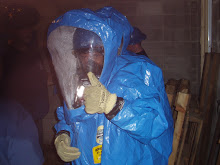
I went to a training class this morning called Fire and Smoke. The instructor was with the Illinois Fire Service Institute. He was great. It is amazing how some times the smoke will tell you whats going on, but other times it does not. You may have heard of the terms backdraft and flashover, but what about smoke explosion? A smoke explosion is when there are super heated gases at their ignition temperature, just waiting for an ignition source. These explosions are strong enough to blow firefighters off their feet. To see an example, check out this video clip. http://www.youtube.com/watch?v=aTQWNCeCBvQ
There was really no advance warning for this except for a couple of seconds before the explosion. It is very important to take time to assess the situation.
Saturday, February 20, 2010

Wednesday, October 14, 2009
Sitting by the pool
Sitting by the pool in a balmy 75 degree morning. Not a bad change from Chicago weather.
When I was on the plane yesterday, I saw a couple with paper respirators on. I did not ask, but were they protecting themselves or the rest of us? With flu season upon us once again, what seemed like weird a couple of years ago is not so weird. How bad is the air quality in a plane traveling at 34,000 ft for two hours? What is on the plane that halfway protects me from getting some bug, if anything? When googling the topic of airplane air quality, I was supprised at what I found. Airplane manufacturers with technical information on cabin air quality, how much extra fuel it takes to supply the passenger cabin with "fresh" air, etc. Pretty interesting how much information you can find if you look, or google. Sifting through the information for what is accurate is sometimes challenging. .
When I was on the plane yesterday, I saw a couple with paper respirators on. I did not ask, but were they protecting themselves or the rest of us? With flu season upon us once again, what seemed like weird a couple of years ago is not so weird. How bad is the air quality in a plane traveling at 34,000 ft for two hours? What is on the plane that halfway protects me from getting some bug, if anything? When googling the topic of airplane air quality, I was supprised at what I found. Airplane manufacturers with technical information on cabin air quality, how much extra fuel it takes to supply the passenger cabin with "fresh" air, etc. Pretty interesting how much information you can find if you look, or google. Sifting through the information for what is accurate is sometimes challenging. .
Monday, October 5, 2009
OSHA’s Hazard Communication Standard
More than 30 million workers are potentially exposed to one or more chemical hazards in the workplace. There are an estimated 650,000 existing hazardous chemical products, and hundreds of new ones are being introduced annually. This poses a serious problem for exposed workers and their employers. The Hazard Communication Standard (HCS) is designed to ensure that employers and employees know about hazardous chemicals in the workplace and how to protect themselves. Employers with employees who may be exposed to hazardous chemicals in the workplace must prepare and implement a written Hazard Communication Program and comply with other requirements of the standard.
All employers in addition to those in manufacturing and importing are responsible for informing and training workers about the hazards in their workplaces, retaining warning labels, and making available Material Safety Data Sheets (MSDS's) with hazardous chemicals.
All workplaces where employees are exposed to hazardous chemicals must have a written plan which describes how the standard will be implemented in that facility. The written program must reflect what employees are doing in a particular workplace. For example, the written plan must list the chemicals present at the site, indicate who is responsible for the various aspects of the program in that facility and where written materials will be made available to employees. The written program must describe how the requirements for labels and other forms of warning, material safety data sheets, and employee information and training are going to be met in the facility.
The HCS covers both physical hazards (such as flammability or the potential for explosions), and health hazards (including both acute and chronic effects). By making information available to employers and employees about these hazards, and recommended precautions for safe use, proper implementation of the HCS will result in a reduction of illnesses and injuries caused by chemicals. Employers will have the information they need to design an appropriate protective program. Employees will be better able to participate in these programs effectively when they understand the hazards involved, and to take steps to protect themselves. Together, these employer and employee actions will prevent the occurrence of adverse effects caused by the use of chemicals in the workplace.
Information adapted from OSHA Fact Sheet No. OSHA 93-26
All employers in addition to those in manufacturing and importing are responsible for informing and training workers about the hazards in their workplaces, retaining warning labels, and making available Material Safety Data Sheets (MSDS's) with hazardous chemicals.
All workplaces where employees are exposed to hazardous chemicals must have a written plan which describes how the standard will be implemented in that facility. The written program must reflect what employees are doing in a particular workplace. For example, the written plan must list the chemicals present at the site, indicate who is responsible for the various aspects of the program in that facility and where written materials will be made available to employees. The written program must describe how the requirements for labels and other forms of warning, material safety data sheets, and employee information and training are going to be met in the facility.
The HCS covers both physical hazards (such as flammability or the potential for explosions), and health hazards (including both acute and chronic effects). By making information available to employers and employees about these hazards, and recommended precautions for safe use, proper implementation of the HCS will result in a reduction of illnesses and injuries caused by chemicals. Employers will have the information they need to design an appropriate protective program. Employees will be better able to participate in these programs effectively when they understand the hazards involved, and to take steps to protect themselves. Together, these employer and employee actions will prevent the occurrence of adverse effects caused by the use of chemicals in the workplace.
Information adapted from OSHA Fact Sheet No. OSHA 93-26
Thursday, October 1, 2009
It got me thinking....
I am sitting on my couch, thinking of how I got this cold and wondering how long it will last. Tis' the season for colds and flus and other such ailments. It got me thinking....
While at a clients, I visited the men's room to wash my hands and noticed a large jug of hand sanitizer setting on the counter. With all the talk about disease transmission, sanitizers are popping up all over the place. I noticed at Home Depot the other night that they have sanitizing wipes at their exit, (maybe it should be at the entrance where the carts are!). There are other public places that also have sanitizers available. This is great for helping to control the spread of easily transmittable bugs. It go me thinking....
Several of my clients are idustrial manufacturers. Even in those environments, everyone seems to be concerned about disease transmition. But what boggles me is that not alot of people are concerned about the chemicals that may be spreading by walking around with contaminated PPE or shoes. This is an area where proper hygiene practices are crucial, especially if the chemicals have highly toxic properties. Selecting the proper PPE and properly donning and doffing that equipment (basically putting on and taking off), is very important steps in protecting ourselves against the hazards of the chemicals they are working with.
When was the last time you washed your hands to make sure there were no chemicals?
I guess that most people are not concerned about chemical exposure
While at a clients, I visited the men's room to wash my hands and noticed a large jug of hand sanitizer setting on the counter. With all the talk about disease transmission, sanitizers are popping up all over the place. I noticed at Home Depot the other night that they have sanitizing wipes at their exit, (maybe it should be at the entrance where the carts are!). There are other public places that also have sanitizers available. This is great for helping to control the spread of easily transmittable bugs. It go me thinking....
Several of my clients are idustrial manufacturers. Even in those environments, everyone seems to be concerned about disease transmition. But what boggles me is that not alot of people are concerned about the chemicals that may be spreading by walking around with contaminated PPE or shoes. This is an area where proper hygiene practices are crucial, especially if the chemicals have highly toxic properties. Selecting the proper PPE and properly donning and doffing that equipment (basically putting on and taking off), is very important steps in protecting ourselves against the hazards of the chemicals they are working with.
When was the last time you washed your hands to make sure there were no chemicals?
I guess that most people are not concerned about chemical exposure
Sunday, September 27, 2009
The changing face of OSHA
OSHA is starting to show teeth!
You may have heard the rumors. OSHA is stepping up their enforcement activities. In addition to increasing the financial cost of civil penalties, they are increasing the criminal penalties for any employer who willfully violates a standard that causes the employee’s death or serious injury.
With the Obama administration comes new faces and directions for the Department of Labor. OSHA is hiring up to 500 new compliance officers and is back in the enforcement business. The days of voluntary programs and alliances are coming to a close.
OSHA is formulating a “Severe Violators Inspection Program” focused on large companies with a violation history, focuses on mandatory follow up inspections, additional locations within the same company now also targeted and enhanced settlement demands.
With the increased enforcement activity, employer’s need to make sure that they are “doing right by their employees” and can document their compliance.
You may have heard the rumors. OSHA is stepping up their enforcement activities. In addition to increasing the financial cost of civil penalties, they are increasing the criminal penalties for any employer who willfully violates a standard that causes the employee’s death or serious injury.
With the Obama administration comes new faces and directions for the Department of Labor. OSHA is hiring up to 500 new compliance officers and is back in the enforcement business. The days of voluntary programs and alliances are coming to a close.
OSHA is formulating a “Severe Violators Inspection Program” focused on large companies with a violation history, focuses on mandatory follow up inspections, additional locations within the same company now also targeted and enhanced settlement demands.
With the increased enforcement activity, employer’s need to make sure that they are “doing right by their employees” and can document their compliance.
Wednesday, September 23, 2009
Scenario Role Playing
I was teaching a group of firefighters this past weekend. We had the final incident for the Hazmat class on Sunday. During this incident, I got the chance, as i try to do for every class, to role play. I am not silver screen quality, but I enjoy myself.
This time I was an owner of a transport company that employed a driver named Fred. Fred started his daily delivery by not only going to the wrong location, but managed to drop off (literally) two drums of hazardous chemicals without knowing he had done so. Fred was probably in the CB radio, since he does not have a phone. He is my sisters cousin, so what's a guy to do!!
While role playing, I got to interact with several of the students with leadership positions in the drill. The more questions they asked, the more information I gave them, most of which had no bearing on the information they were trying to get out of me. I finally gave in and gave them bits of information that they needed for sucessful completion of the drill. It is always interesting to see how people react when they ask you a serious question, and your reply is not only drawnout, but has no bearing on their question. I kept them tied up for 10 minutes with just continuous rambling and off topic discussions.
When role playing, I play particular attention to the questions and terminology that are used. For example, a placard on a truck can either mean the DOT placard for hazmat or to not hazmaters, it could be the signs on the trucks that are used for identification. It depends on the information that you are looking for.
Role playing is a great way to enhance your training and can be used for a variety of topics. It allows the students to put in to practice what they have learned in the classroom.
This time I was an owner of a transport company that employed a driver named Fred. Fred started his daily delivery by not only going to the wrong location, but managed to drop off (literally) two drums of hazardous chemicals without knowing he had done so. Fred was probably in the CB radio, since he does not have a phone. He is my sisters cousin, so what's a guy to do!!
While role playing, I got to interact with several of the students with leadership positions in the drill. The more questions they asked, the more information I gave them, most of which had no bearing on the information they were trying to get out of me. I finally gave in and gave them bits of information that they needed for sucessful completion of the drill. It is always interesting to see how people react when they ask you a serious question, and your reply is not only drawnout, but has no bearing on their question. I kept them tied up for 10 minutes with just continuous rambling and off topic discussions.
When role playing, I play particular attention to the questions and terminology that are used. For example, a placard on a truck can either mean the DOT placard for hazmat or to not hazmaters, it could be the signs on the trucks that are used for identification. It depends on the information that you are looking for.
Role playing is a great way to enhance your training and can be used for a variety of topics. It allows the students to put in to practice what they have learned in the classroom.
Monday, September 21, 2009
I have been studying all day for a professional certification test that is scheduled for later this week. The certification is for a Certified Hazardous Materials Manager. There is a lot of regulations that come into play when dealing with hazardous materials. In addition to their specific language, each regulation has their own terminology for Hazmat. For instance, here is what I mean.
Hazardous Materials (U.S. DOT)
Hazardous Chemicals (OSHA)
Hazardous Substances (CERCLA)
Hazardous Waste (U.S. EPA & DOT)
Extremely Hazardous Substances (U.S. EPA)
It would be much easier if everyone spoke the same language. The chemicals have not changed, just the way each regulatory agency views its' interaction with chemicals.
I am relatively new to blogging, so with time, my posts will include pictures and if I am really ambitious, some videos.
One last thought, before hitting the books. Even though powerpoints as a training tool are a necessary evil, I like to provide my students and clients with hands on skills testing and problem solving. If you have any thoughts or ideas in this area, please let me know. I would love to learn about them.
Thanks to ckempt for a blog mention. His blog is on my blog roll, "life under the lights". Check it out
Stay safe,
Hazardous Materials (U.S. DOT)
Hazardous Chemicals (OSHA)
Hazardous Substances (CERCLA)
Hazardous Waste (U.S. EPA & DOT)
Extremely Hazardous Substances (U.S. EPA)
It would be much easier if everyone spoke the same language. The chemicals have not changed, just the way each regulatory agency views its' interaction with chemicals.
I am relatively new to blogging, so with time, my posts will include pictures and if I am really ambitious, some videos.
One last thought, before hitting the books. Even though powerpoints as a training tool are a necessary evil, I like to provide my students and clients with hands on skills testing and problem solving. If you have any thoughts or ideas in this area, please let me know. I would love to learn about them.
Thanks to ckempt for a blog mention. His blog is on my blog roll, "life under the lights". Check it out
Stay safe,
Subscribe to:
Posts (Atom)